

The opioid crisis has reached epidemic proportions, affecting millions of individuals and families across the globe. In the United States, the opioid epidemic has been declared a public health emergency, resulting in more than 79,358 deaths alone in 2023, and opioid-related mortality is continually rising. Many overdosed patients are found alone and unconscious, unable to use existing antidote sprays and injectors solutions. Antidote administration is delayed until EMS arrives and such delay leads to a multitude of problems, including hypoxemia, brain damage, intensive care, and high healthcare costs.
According to the Joint Economic Committee, the economic burden of Opioid Use Disorder (OUD) and fatal overdoses had already totaled to $1.5 trillion in 2020 - up 37% from 2017, last measured by the CDC. As the epidemic has only worsened significantly over time, we can only expect this number to be higher.
Revolutionizing opioid overdose detection and treatment
Discrete. Comprehensive. Automatic.
Progression of dependency
Widespread opioid prescription

37.5 prescriptions dispensed per 100 persons in 2023
Post-surgical pains, cancer pain management, traumatic injuries, dental procedures, etc.
High addiction potential
11% of those prescribed opioids develop an addiction
Addiction develops due to stimulation of brain’s reward pathway and tolerance build
Threat of fatal overdose
~80,000 opioid- involved overdose deaths in 2023
Overdoses often occur fast and alone, rendering current solutions ineffective
While opioids are effective for pain management, they also bind to receptors in the brainstem that control respiration, leading to opioid-induced respiratory depression, the primary cause of fatal overdoses. Despite the widely available antidote, naloxone, the number of opioid-related overdose deaths remains unacceptably high.
A2D2 reverses opioid overdoses automatically.
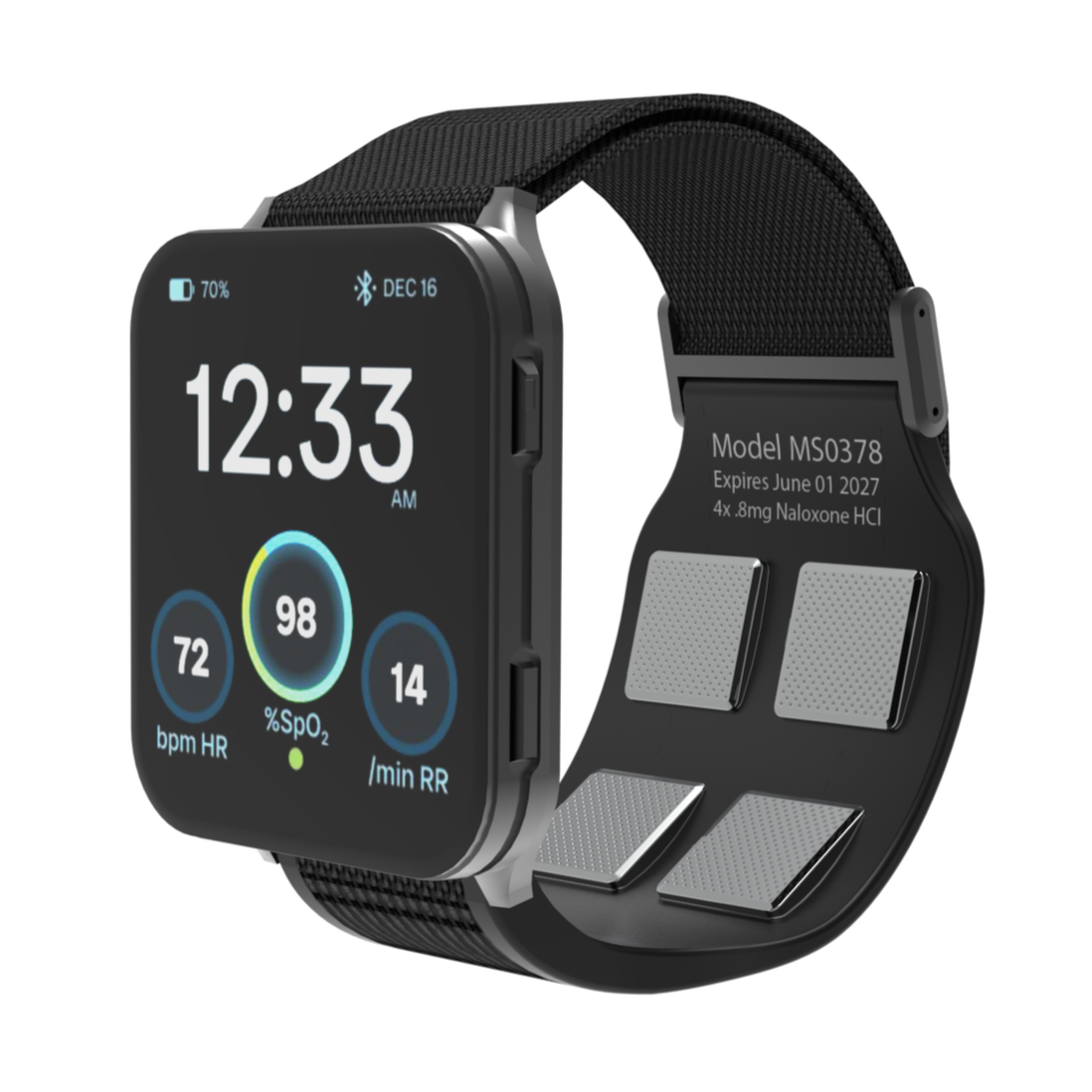
3D rendering - product in development
Rescue Biomedical’s Automatic Antidote Delivery Device (A2D2) is a innovative wearable device that automatically detects and treats opioid overdose, establishing a closed-loop drug-delivery system.
Upon detection of an overdose, the A2D2 autonomously administers naloxone through a needle-free injector to restore normal breathing while simultaneously alerting emergency contacts to ensure further medical intervention.